How Anonymixer Works
The full mechanics of the pool-routing protocol, written for the kind of reader who wants to understand the system before trusting it.
Overview of the protocol
Anonymixer operates as a non-custodial bitcoin mixer with a continuously rebalanced reserve. The protocol is built on three primitives: a shared liquidity pool, a randomized delay queue, and a fee component that introduces controlled amount-noise. Each primitive defeats a specific category of chain-analysis heuristic, and together they produce a withdrawal that cannot be linked back to the deposit using public on-chain data alone.
This is not a technical novelty. Pool-based mixing is well understood in the literature. What Anonymixer contributes is a careful operational discipline around it — short-lived logs, signed receipts, and pool depth that is published in real time so users can make an informed choice about when to mix.
The liquidity pool
The pool is a working balance maintained by Anonymixer. It is funded by the steady inflow of prior mixes, by partner liquidity providers, and by an operator float that exists specifically so the first user of any new pool epoch does not stand out. When a deposit arrives, it is credited internally to the pool's accounting ledger. When a withdrawal is due, it is paid out from coins that were already sitting in the pool — typically from a different epoch than the deposit.
The practical effect is straightforward: the bitcoin you receive from Anonymixer is almost never the bitcoin you sent. Your deposit becomes part of the pool's future capacity. Your withdrawal draws from the pool's accumulated history. The on-chain link is broken at the pool boundary.
Why the delay matters
Time-delay is the single most underrated privacy feature in mixer design. If a withdrawal happens five seconds after a matching deposit, no amount of pool sophistication will protect the user — a timing analyst will simply look for the nearest matching outflow. By forcing every withdrawal to wait inside a chosen window, Anonymixer ensures that dozens or hundreds of unrelated transactions enter and leave the pool during the delay, expanding the anonymity set in proportion to the waiting time.
This is also why Anonymixer caps the delay at seventy-two hours rather than offering an open-ended option. A pool that holds coins indefinitely starts to look like custody, and custody is the architectural failure mode this design exists to avoid.
Anonymity set, in plain language
The anonymity set is the group of people any outside observer would have to consider as the possible sender of a given withdrawal. The larger that group, the weaker any specific accusation. Anonymixer publishes the rolling pool depth so users can decide whether the current set size meets their threshold before depositing.
The fee component
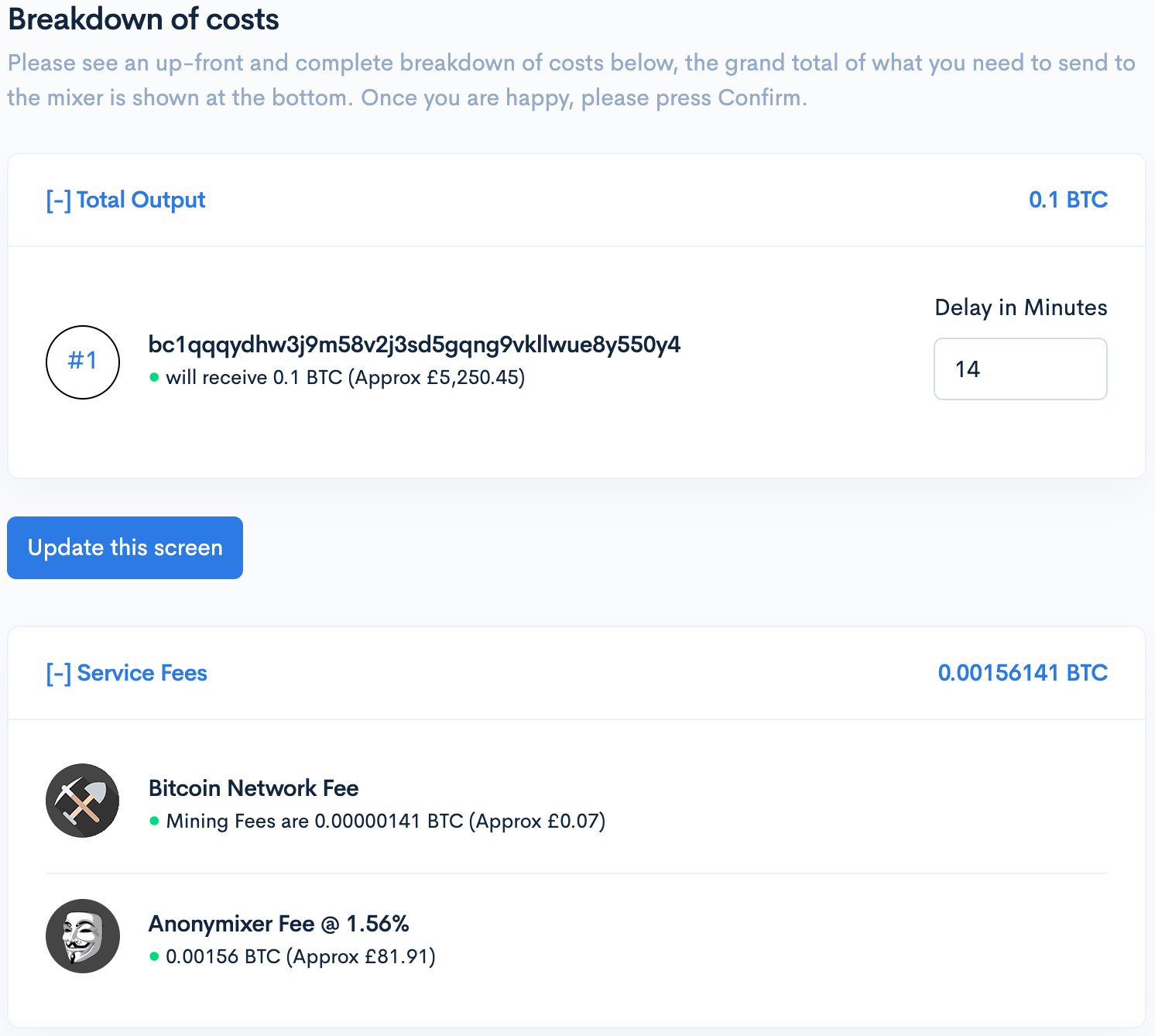
Anonymixer charges 0.7% as a base fee, with a small randomized component added on each mix. Most mixers price flat, which means a deposit of one bitcoin produces a withdrawal of a predictable fraction of one bitcoin — a clue that anyone with a chain-analysis tool can use. The randomized component is intentionally noisy: it makes withdrawal amounts inexact-by-design, so an observer cannot work backwards from a clean number on the receiving end.
Protocol notes
A few details that the engineering-minded user will want explicitly:
- Deposit addresses are single-use. Sending twice to the same address is treated as a single combined mix, not two separate ones.
- The letter of guarantee is PGP-signed against a key whose fingerprint is published on every page of this site and on the onion mirror.
- Withdrawals are paid in batches that include unrelated mixes, so the broadcast transaction itself is a small CoinJoin in effect.
- No Javascript is required for the deposit flow. The site is usable in a hardened browser with scripts disabled.
What Anonymixer is not
Anonymixer is not an exchange, not a custodial wallet, and not a financial product. It is a privacy tool for users who already hold bitcoin and would prefer that the act of holding it remain their own business. The service does not store user funds beyond the time required to complete a mix, and it does not offer to convert between currencies.
Try Anonymixer with a small test mix first
Every careful user does a dry run. We recommend it.
Open the mixing guide →